
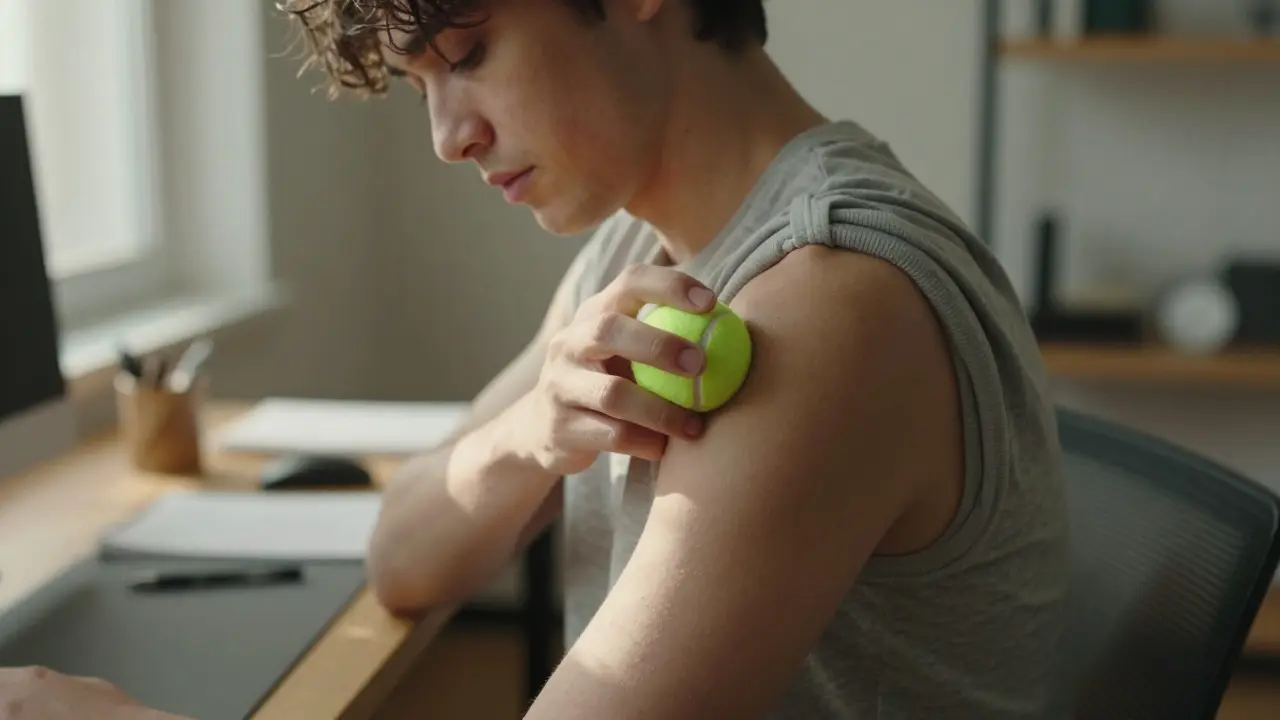
Most people think pain relief means pills, ice packs, or long waits for a doctor’s appointment. But what if the key to stopping your shoulder pain, lower back ache, or chronic headaches was just a few targeted presses with your thumb? Trigger point massage isn’t new, but it’s still one of the most underused tools in pain management. It doesn’t require fancy equipment. You don’t need a prescription. And it works faster than you’d expect.
What Exactly Is a Trigger Point?
A trigger point isn’t just a sore spot. It’s a tight, knotted band of muscle fiber that refuses to relax. Think of it like a tangled headphone cord inside your muscle. When you press on it, you don’t just feel pain at the spot-you feel it shoot down your arm, up into your head, or over to your hip. That’s called referred pain. It’s why people with headaches often blame their sinuses when the real culprit is a knot in their upper trapezius muscle.
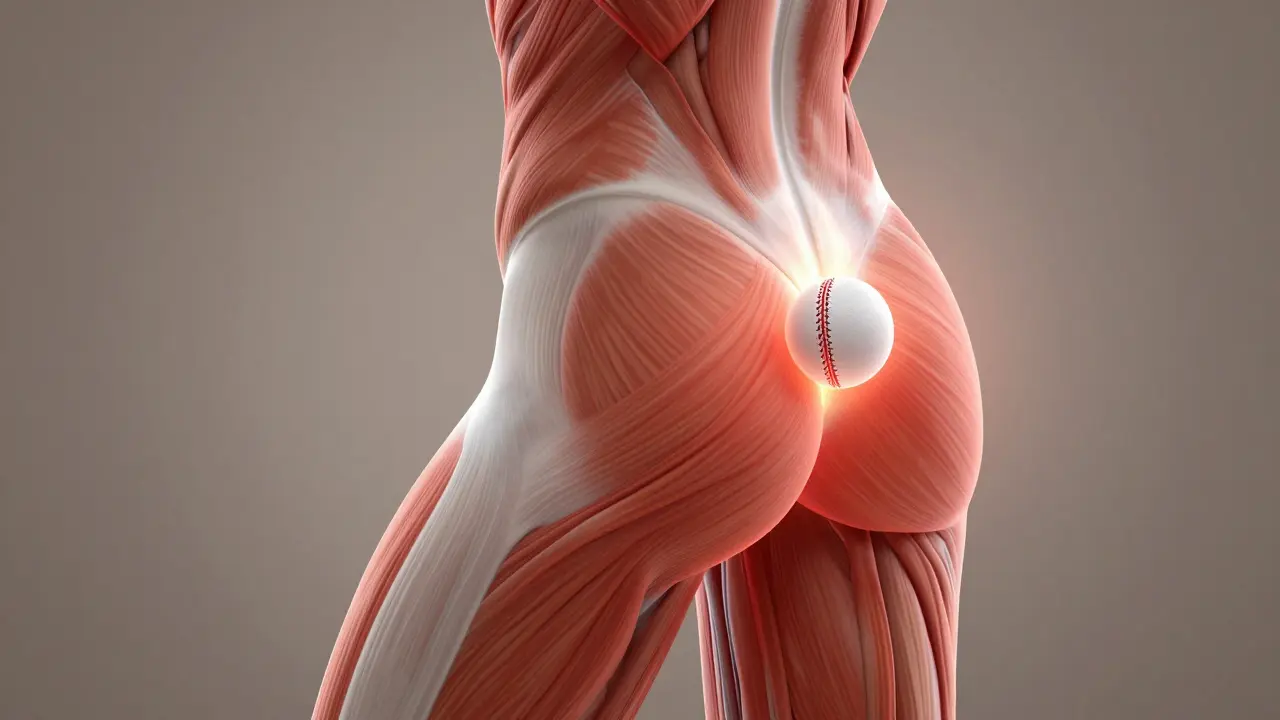
These knots form from overuse, poor posture, stress, or injury. Sitting at a desk for hours? Your levator scapulae muscles are tightening. Carrying a heavy bag on one shoulder? Your rhomboids are screaming. Running without stretching? Your glutes are locking up. And once these trigger points set in, they don’t just hurt-they make nearby muscles weaker, stiffen your movement, and even mess with your sleep.
How Trigger Point Massage Works
Trigger point massage works by breaking the pain-spasm-pain cycle. When a muscle is stuck in constant contraction, it cuts off its own blood supply. No blood flow means no oxygen, no healing, and more pain. Pressing directly on the trigger point for 30 to 60 seconds forces blood back in. It’s not gentle. It’s not supposed to be. You’re not trying to relax the muscle-you’re reprogramming it.
The pressure should be intense but bearable. Think of it like the difference between a light rub and digging into a bruise. If it feels like a 7 out of 10 on the pain scale, you’re in the right zone. Too light? It won’t do anything. Too hard? You’ll tense up and fight it. The goal is to hold the pressure until the knot softens, the pain dulls, and your body sighs. That usually takes 30 to 90 seconds. Do it three times a day, and you’ll start noticing changes in about a week.
Where to Find the Most Common Trigger Points
Not all knots are created equal. Some are easy to find. Others hide deep. Here are the top five troublemakers most people overlook:
- Upper trapezius (top of your shoulder, near your neck): This is the #1 source of tension headaches. Press right where your neck meets your shoulder blade. You’ll feel pain radiating into your temple.
- Levator scapulae (side of your neck, below the ear): If your neck feels stiff when you turn your head, this is likely the culprit. Press diagonally down toward your shoulder blade.
- Gluteus medius (side of your hip): This one causes lower back pain and sciatica-like symptoms. Sit on a tennis ball and shift your weight side to side.
- Iliotibial band (IT band) (outer thigh): Runners and cyclists often mistake this for knee pain. Roll your thigh over a foam roller, focusing on the area just above the knee.
- Masseter (jaw muscle): Clenching your teeth at night? This knot can cause earaches, tooth pain, and even dizziness. Press gently inside your cheek, near the back molars.
These aren’t guesses. They’re backed by decades of clinical research in myofascial pain syndrome. A 2021 study in the Journal of Bodywork and Movement Therapies found that 89% of patients with chronic neck pain had active trigger points in the upper trapezius. And 73% of them saw significant improvement after just two weeks of daily self-massage.
Tools You Can Use at Home
You don’t need to spend hundreds on gadgets. A tennis ball, a lacrosse ball, or even a frozen water bottle works wonders. Here’s what works best:
- Tennis ball: Perfect for broad areas like your back or glutes. Toss it against a wall and lean into it.
- Lacrosse ball: Harder and smaller. Great for deep knots in the hips, shoulders, or feet.
- Foam roller: Best for long muscles like quads, hamstrings, and calves. Roll slowly-no bouncing.
- Massage stick or roller: Good for arms and legs when you need precision.
- Your fingers: Sometimes, nothing beats your own thumb. Especially for the neck, jaw, and hands.
Pro tip: Use heat before you massage. A warm shower or heating pad for 10 minutes loosens the tissue. Cold after? Helps reduce inflammation if you’re sore. Don’t skip this step.
What Trigger Point Massage Won’t Do
It’s not magic. And it’s not a cure-all. If you have a herniated disc, nerve damage, or a fracture, this won’t fix it. Trigger point massage treats muscle-based pain, not structural issues. If your pain is sharp, electric, or numb, stop and see a professional.
Also, don’t expect instant relief. Some knots take weeks to release. You might feel worse before you feel better. That’s normal. Your body is rewiring its pain signals. Stick with it. Consistency beats intensity.

When to See a Professional
Self-massage is powerful, but it has limits. If after three weeks of daily work you’re not improving, it’s time to get help. A licensed massage therapist trained in myofascial release can find knots you can’t reach and apply deeper, targeted pressure. Physical therapists can also teach you stretches and posture corrections to stop the knots from coming back.
And if you’re dealing with pain that spreads, worsens at night, or comes with fever or weight loss-don’t mess around. That’s not a trigger point. That’s something else entirely.
Real-Life Results
One woman in Durham, 58, had chronic headaches for eight years. She’d tried acupuncture, chiropractors, and migraine meds. Nothing stuck. Then she started pressing on her upper trapezius for five minutes every morning. Within ten days, her headaches dropped from daily to twice a week. After three weeks, they were gone. She didn’t change her diet. She didn’t quit her job. She just found the knot.
Another man, 42, thought his lower back pain was from lifting weights. He’d been to three physiotherapists. Then he rolled his glutes on a lacrosse ball every night. His pain vanished in 11 days. He didn’t know the glutes could cause back pain. Most people don’t.
Make It a Habit
Trigger point massage isn’t a treatment. It’s a maintenance habit-like brushing your teeth. Do it before your shower. Do it while watching TV. Do it while waiting for your coffee to brew. Keep a tennis ball by your desk. Keep a foam roller by your bed.
Start with one area. Master it. Then move to the next. Your body will thank you. And you’ll wonder why no one ever told you this before.
Can trigger point massage help with migraines?
Yes, but only if the migraines are triggered by muscle tension. Many people with chronic migraines have tight muscles in their neck and shoulders that pull on nerves and blood vessels. Pressing on trigger points in the upper trapezius and levator scapulae can reduce frequency and intensity. It won’t help if the migraine is caused by hormones, light sensitivity, or neurological issues-but if stress and posture are part of the problem, this method works.
How long should I hold pressure on a trigger point?
Hold for 30 to 90 seconds. You’ll know you’re doing it right when the pain starts to dull, the muscle softens, or you feel a release-like a knot unraveling. Don’t rush it. The goal isn’t to hurt more, but to reset the muscle’s tension. If you release too soon, you won’t get results.
Is trigger point massage the same as deep tissue massage?
No. Deep tissue massage works on broad areas of muscle, using sweeping strokes to release overall tension. Trigger point massage is focused. It targets one specific knot with direct, sustained pressure. One is like massaging your whole back. The other is like poking a single, painful spot until it lets go.
Can I do trigger point massage if I have arthritis?
Yes, but be careful. Trigger point massage targets muscles, not joints. If your pain comes from tight muscles around an arthritic joint, this can help reduce strain. But avoid pressing directly on swollen, hot, or unstable joints. Always check with your doctor first if you have severe osteoarthritis or rheumatoid arthritis.
Why does pressing on a knot in my shoulder cause pain in my hand?
That’s referred pain. Trigger points don’t just hurt where they are-they send pain signals to other areas. A knot in your upper trapezius can cause pain in your thumb or index finger. A knot in your glute can mimic sciatica. It’s confusing, but it’s normal. The nerves from the knot’s location share pathways with nerves in distant areas. That’s why identifying the real source matters more than treating the symptom.